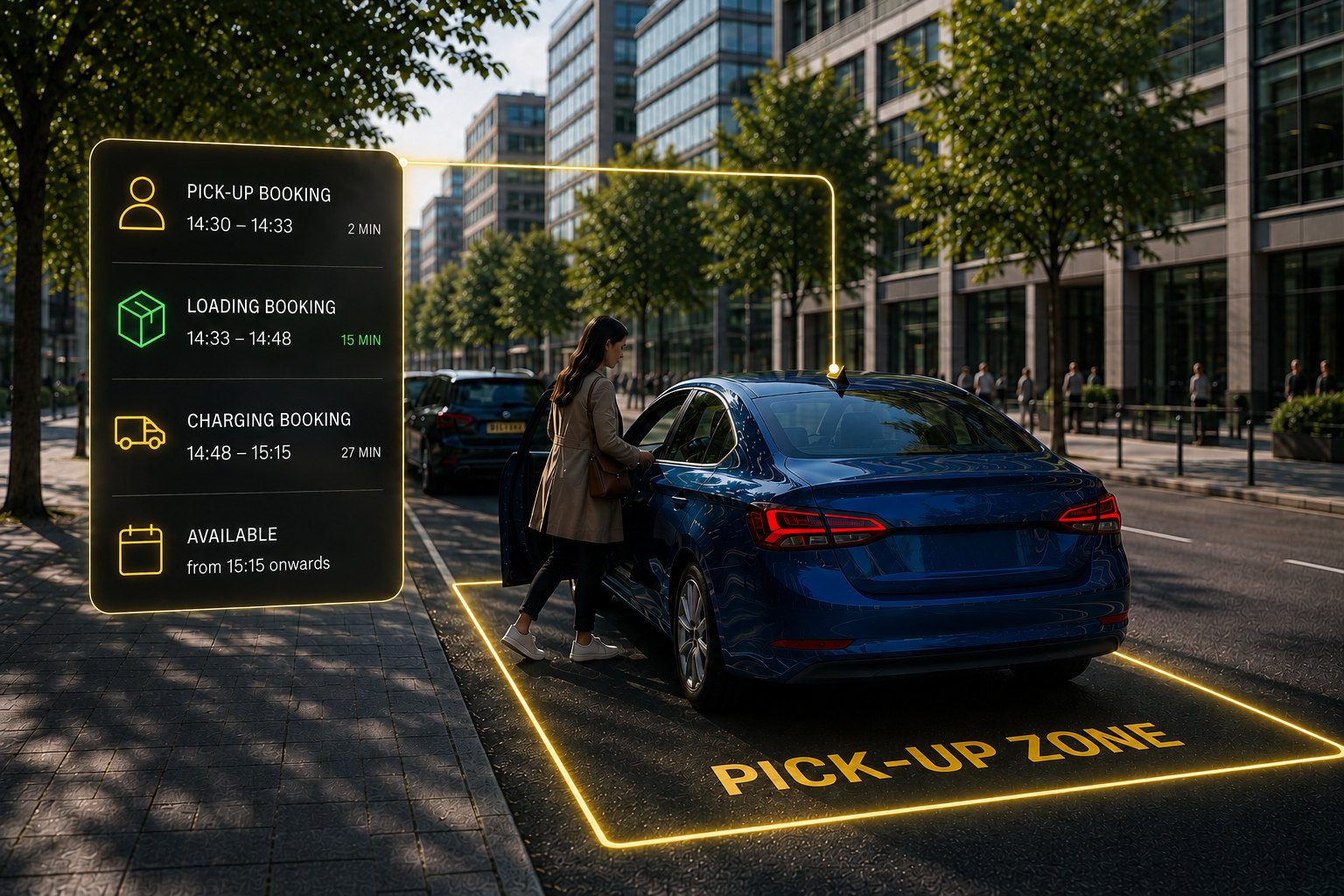
Research combining sensors, self-reported surveys, and GPS data offers early insight into the human toll of urban kerbside congestion and the potential of digital tools to help.
A newly published pilot study investigates whether pre-bookable loading bays can ease the stress experienced by freight delivery drivers navigating one of London’s busiest kerbside environments. The research, “The impact of bookable loading bays on stress levels of freight drivers – A pilot study,” was published in Transportation Research Procedia (Vol. 98, 2026) and presented at the 13th International Conference on City Logistics.
The study was conducted by Juan Pablo Castrellon and Ivan Sanchez-Diaz of Chalmers University of Technology, together with Michael Browne and Cecilia Bergstad of the University of Gothenburg and industry partners coordinated by John Crosk, Chairman of the Brewery Logistics Group and Grid Smarter Cities.
Why it Matters
Freight drivers routinely face conflict-prone conditions, congested streets, competition for limited kerbside space, and the constant risk of parking fines, all of which contribute to emotional stress. Prior research has linked this kind of stress to unsafe driving behaviour, slower reaction times, and long-term health consequences. For freight companies, driver stress also translates into real costs: reduced productivity, higher turnover, and increased sick leave.
To address these pressures, cities have increasingly turned to kerbside digitalisation, technology that lets drivers reserve loading space in advance rather than search for it on arrival. Until now, the effects of these tools had mainly been evaluated in economic, traffic, and environmental terms. This study is among the first to examine their impact on driver wellbeing directly.
What the Research Did
In partnership with Grid Smarter Cities, Southwark Borough Council, and the Brewery Logistics Group, the research team studied deliveries in London’s Borough Market, an area with intense competition for kerbside access. Five Virtual Loading Bays (VLBs), a pre-booking system allowing drivers to secure up to 90 minutes of loading time in advance, were installed for the pilot.
Two delivery crews were monitored across 17 tracked trips between November 27 and December 28, 2024, both before and after VLB implementation. The team combined three sources of data:
- GPS data linking physiological signals to specific locations along each journey.
- Electrodermal activity, pulse rate, and skin temperature, captured via wearable sensors and converted into a composite stress score.
- Self-reported surveys measuring perceived stress and self-efficacy before and after each delivery route.
Understanding the Challenges Drivers Face
The study reinforces what many delivery operators already know: uncertainty around finding safe and legal loading space is a significant source of stress during urban deliveries.
Participants reported that having access to bookable loading bays improved confidence when arriving at delivery locations by reducing the uncertainty associated with searching for available kerbside space.
While the physiological measurements did not produce statistically significant differences within this small pilot study, they broadly supported the trends observed through driver feedback and demonstrated the feasibility of using wearable technology to assess stress in live operational environments.
The authors conclude that larger studies will help build on these findings and further explore the relationship between digital kerbside management and driver wellbeing.
Supporting Better Outcomes For Cities and Operators
For Grid Smarter Cities, the research reflects an important shift in how the success of kerbside management is measured.
Digital kerbside infrastructure has traditionally been evaluated through operational outcomes such as reduced congestion, improved compliance and increased delivery efficiency. This research adds another important dimension by considering the experience of the people using the kerb every day.
By reducing uncertainty around where deliveries can be made, digital booking systems have the potential to support not only more efficient freight operations but also improved working conditions for drivers navigating increasingly complex urban environments.
As cities continue to balance competing demands for limited kerbside space, understanding these human factors will become increasingly important in designing transport systems that work for everyone.
Read the Research
The full paper, “Assessing Stress in Urban Freight Deliveries: An Interdisciplinary Approach Combining Physiological and Transport Data”, is now available online in Transportation Research Procedia.
You can read the paper here:
About Grid Smarter Cities:
We specialise in building sustainable digital products that enable the smarter management of kerbside and freight logistics. Our knowledge of the ecosystem at the kerbside enables us to work with clients such as local authorities and operators to solve their challenges and with a tech solution at the kerbside.