Grid Smarter Cities Founder and recent BPA 2026 Lifetime Achievement Award winner, Neil Herron, explores in this month’s edition of Parking Review why preparing for autonomous vehicles requires cities to think beyond the technology inside the vehicle and towards the digital infrastructure needed to manage where they stop.
Connected and autonomous vehicles are moving rapidly from concept towards reality. Across the industry, attention is understandably focused on whether these vehicles can safely navigate increasingly complex urban environments.
But there’s another question cities need to be asking: can they effectively orchestrate autonomous vehicles once they arrive?
In the latest edition of Parking Review, Grid Smarter Cities Founder Neil Herron explores why the future of autonomous mobility will depend as much on the kerbside as it does on the vehicle itself.
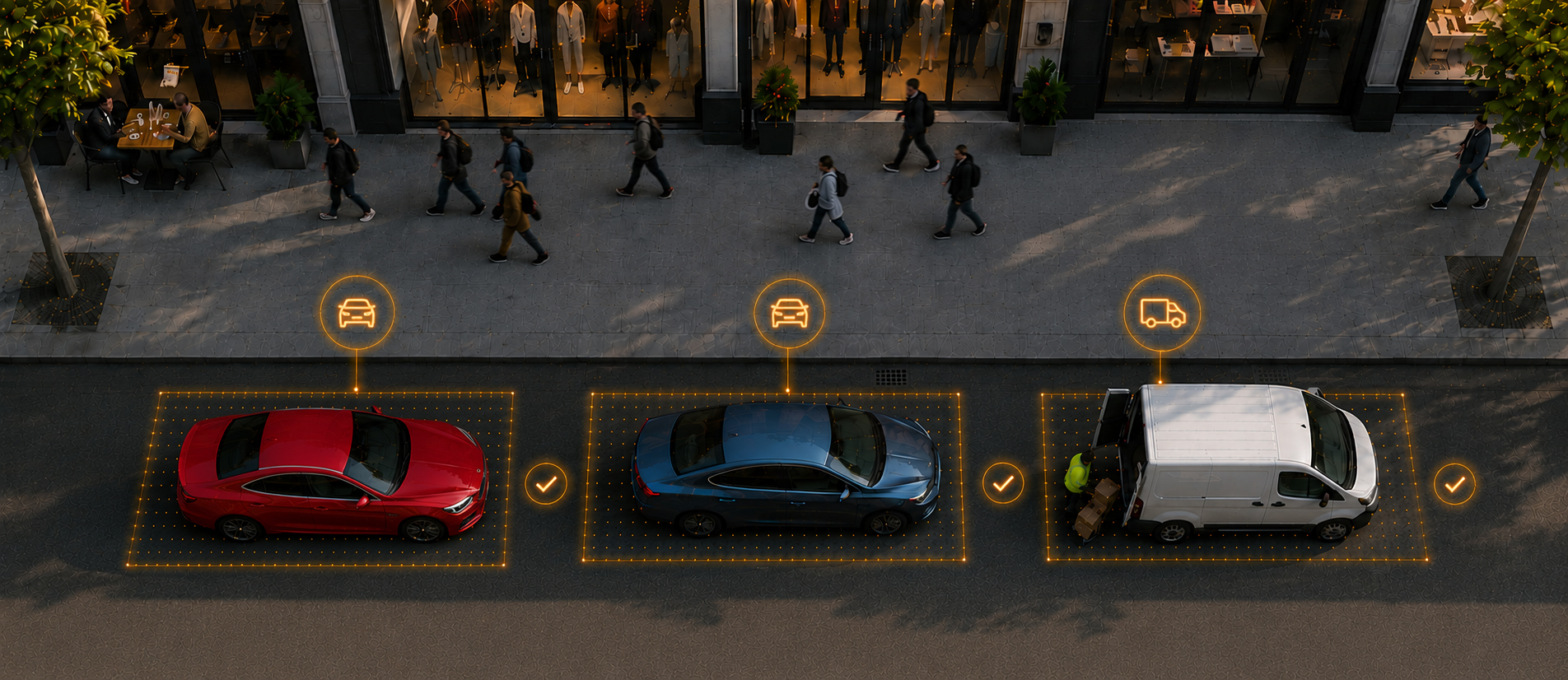
Every autonomous journey ends at the kerb
However sophisticated an autonomous vehicle becomes, every journey still begins and ends somewhere. Passenger pick-ups and drop-offs, deliveries, charging, servicing, vehicle staging and accessibility requirements will all create demand for the same limited kerbside space.
As Neil puts it:
“Parking is no longer simply about enforcing restrictions. It is about becoming an integral part of how cities orchestrate movement”
Without a way of coordinating this growing demand, cities risk replacing one transport challenge with another. Hundreds of vehicles independently searching for somewhere to stop could create congestion even if every individual vehicle is operating exactly as intended.
The challenge, therefore, isn’t simply vehicle automation. It’s kerbside orchestration.
From fixed rules to dynamic permissions
The good news is that the foundations of this approach already exist. Through projects such as the Walworth Road Bookable Loading Bays and Virtual Loading Bays, Grid has shown how kerbside access can move beyond static signs, road markings and restrictions towards a digitally managed model, with freight operators reserving loading space before beginning their journey, giving them greater certainty over where they can stop while local authorities retain control of the asset.
Research undertaken with Durham University builds on this further, exploring how optimisation techniques could reschedule access in real time when delays occur, providing evidence of how responsive bookable kerbside infrastructure can become.
Now imagine applying the same principle to autonomous mobility. Rather than a vehicle simply stopping wherever a passenger requests, it could digitally request permission to access the kerb, with a city’s platform assessing demand, traffic conditions, accessibility needs and local policy before allocating the most appropriate location.
A new role for the kerbside
This isn’t about removing control from local authorities; it’s about giving them better tools to apply their own policies. For local authorities and parking professionals, autonomous mobility is an opportunity to rethink the role of kerbside management altogether.
Parking is increasingly about more than enforcing restrictions. The expertise built up around parking policy, regulation, enforcement and compliance could become central to how cities coordinate the mobility of the future, allocating access intelligently, communicating with infrastructure digitally, and applying local policy in real time.
The technology to begin that transition already exists. What’s needed now is for cities, policymakers, transport operators and technology providers to build the ecosystem together.
As Neil concludes in Parking Review, the future won’t belong simply to those developing autonomous vehicles, it will belong to those who recognise that smart mobility starts before a vehicle even begins moving. It starts with how intelligently we manage where it’s allowed to stop.
To find out how Grid Smarter Cities is helping local authorities and transport operators prepare for the next generation of digitally managed kerbside infrastructure, get in touch at info@gridsmartercities.com
About Grid Smarter Cities:
We specialise in building sustainable digital products that enable the smarter management of kerbside and freight logistics. Our knowledge of the ecosystem at the kerbside enables us to work with clients such as local authorities and operators to solve their challenges and with a tech solution at the kerbside.